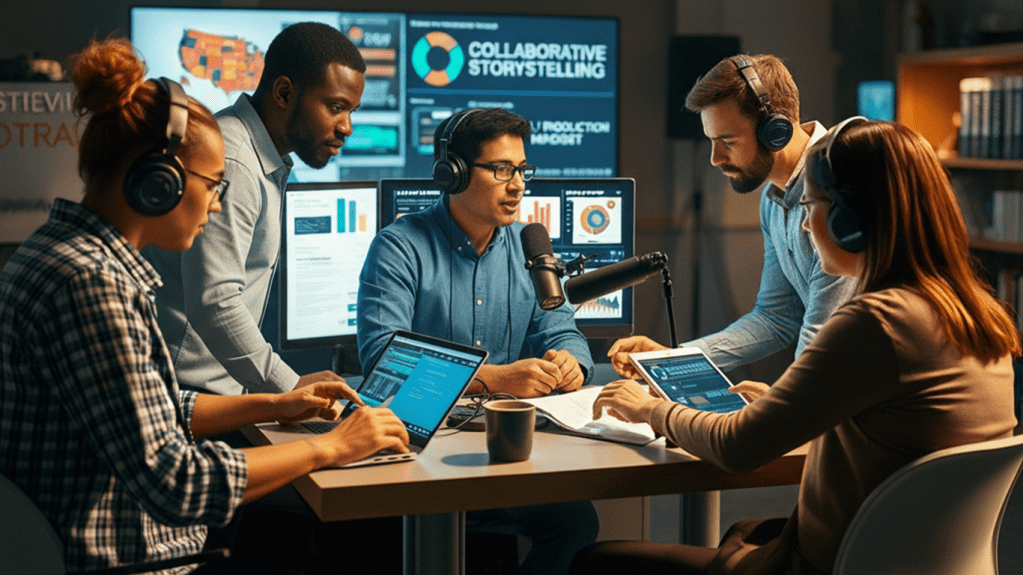
When people talk about digital media, they usually talk about platforms — websites, apps, social feeds, streaming services. Over the years, I’ve learned that platforms matter far less than how teams think and work.
Digital media is not a destination. It’s a production mindset.
That mindset assumes stories will move across formats, evolve over time and be shaped by collaboration between people with very different strengths.
The Most Successful Teams Weren’t Built Around Titles
Some of the strongest digital and multimedia work I’ve led came from teams that weren’t uniformly “digital natives.”
They included:
- Producers with broadcast instincts
- Reporters and anchors with deep subject-matter expertise
- Designers and developers fluent in visual systems
- Editors focused on clarity, structure and standards
- Team members who were simply curious and willing to learn
What united them wasn’t identical skill sets, it was a shared commitment to problem-solving and audience service.
Digital success came from collaboration, not specialization silos.
Production Thinking Changes the Conversation Early
A production mindset changes how stories are discussed from the very beginning. Instead of asking, “Where will this publish?” teams asked:
- What’s the best way to tell this story?
- Does it need visuals, data, or interactivity to be understood?
- How might this live beyond a single moment or format?
This approach allowed teams to plan holistically — considering text, video, audio, graphics, livestreams and interactive elements as complementary tools rather than competing priorities.
Distribution Is Part of Production—Not an Afterthought
One of the most important shifts we made in our digital workflows was treating distribution and promotion as part of the production process, not something bolted on at the end.
For major stories, we intentionally kept a social media or audience engagement specialist attached to the project from the earliest stages of development.
Their role wasn’t to write posts after publication. It was to help shape how the story could travel.
Why This Changed the Work for the Better
By involving promotion specialists early, teams began asking better questions:
- What elements of this story are most shareable and why?
- Are there moments we should capture specifically for social platforms?
- What visuals or language will help this resonate beyond our owned channels?
- How can we maintain editorial integrity while expanding reach?
This collaboration influenced everything from headline framing to visual choices to sequencing of publication.
The result wasn’t clickbait. It was intentional storytelling designed to meet audiences where they already were.
Social Media as Editorial Insight
Audience and social specialists often bring a different kind of expertise to the table — one grounded in real-time feedback, platform behavior and audience curiosity.
When their insight is included early:
- Promotion becomes more authentic
- Stories travel further without being distorted
- Editorial teams gain a clearer picture of how work is received
This approach also reduced friction after publication. Promotion plans were already aligned with editorial intent, rather than rushed or reactive.
The leadership lesson, treating social media as part of production sends a powerful signal:
- Distribution matters
- Audience matters
- Collaboration matters
It also reinforces a culture where marketing, communications and editorial teams aren’t siloed — they’re aligned.
In digital media, a story isn’t finished when it’s published. It’s finished when it reaches — and resonates with — the audience it was created for.
When Diverse Skills Produce Award-Winning Work
Many of the projects I’m most proud of — and that later earned external recognition — were built by teams that blended experience levels and disciplines.
These included:
- Interactive storytelling projects that paired editorial judgment with technical execution
- Multimedia coverage that combined live production, post-production and digital distribution
- Data-driven and visual explainers developed by people who didn’t start their careers as developers
- Large-scale storytelling efforts that required coordination across editorial, design and production teams
The common thread wasn’t technical perfection. It was shared ownership.
When people felt empowered to contribute outside their traditional roles, the work became stronger—and more resilient.
Digital Production Is a Team Sport
Digital media rewards teams that communicate well under pressure. In practice, that meant:
- Creating workflows that valued input from multiple disciplines
- Encouraging questions rather than guarding expertise
- Designing processes that allowed people to grow into new skills
- Making space for experimentation without fear of failure
Leaders play a critical role here. My job was often less about having the best idea and more about creating the conditions where good ideas could surface.
Awards Are a Byproduct, Not the Goal
Some of this work went on to receive industry recognition — not because it chased trends, but because it reflected:
- Clear editorial purpose
- Thoughtful production choices
- Strong collaboration
- Respect for audience needs
Awards validate process more than product. They’re signals that teams, strategy and execution were aligned.
Why This Mindset Still Matters
Today’s media and communications environments are shaped by constant change—new platforms, new tools, new pressures. A platform-first mindset ages quickly.
A production mindset lasts.
It allows organizations to adapt without losing their voice, empowers teams to evolve together and keeps storytelling focused on impact rather than novelty.
The Leadership Takeaway
Digital media doesn’t succeed because of platforms. It succeeds because of people working well together.
When teams are collaborative, diverse in skill and experience and aligned around purpose, the work rises—regardless of where it’s published.
That’s the mindset I’ve carried across newsrooms, digital teams and institutional communications—and it’s the one I believe produces the most meaningful, durable work.
 Mario Sevilla